

Equal Lows (EQLs) Explained: Definition, Strategy & Common Mistakes
An equal low (EQL) is a bullish market structure signal formed when price tests the same swing low twice and rejects. Learn what EQLs are, how to identify them, and how to trade them.

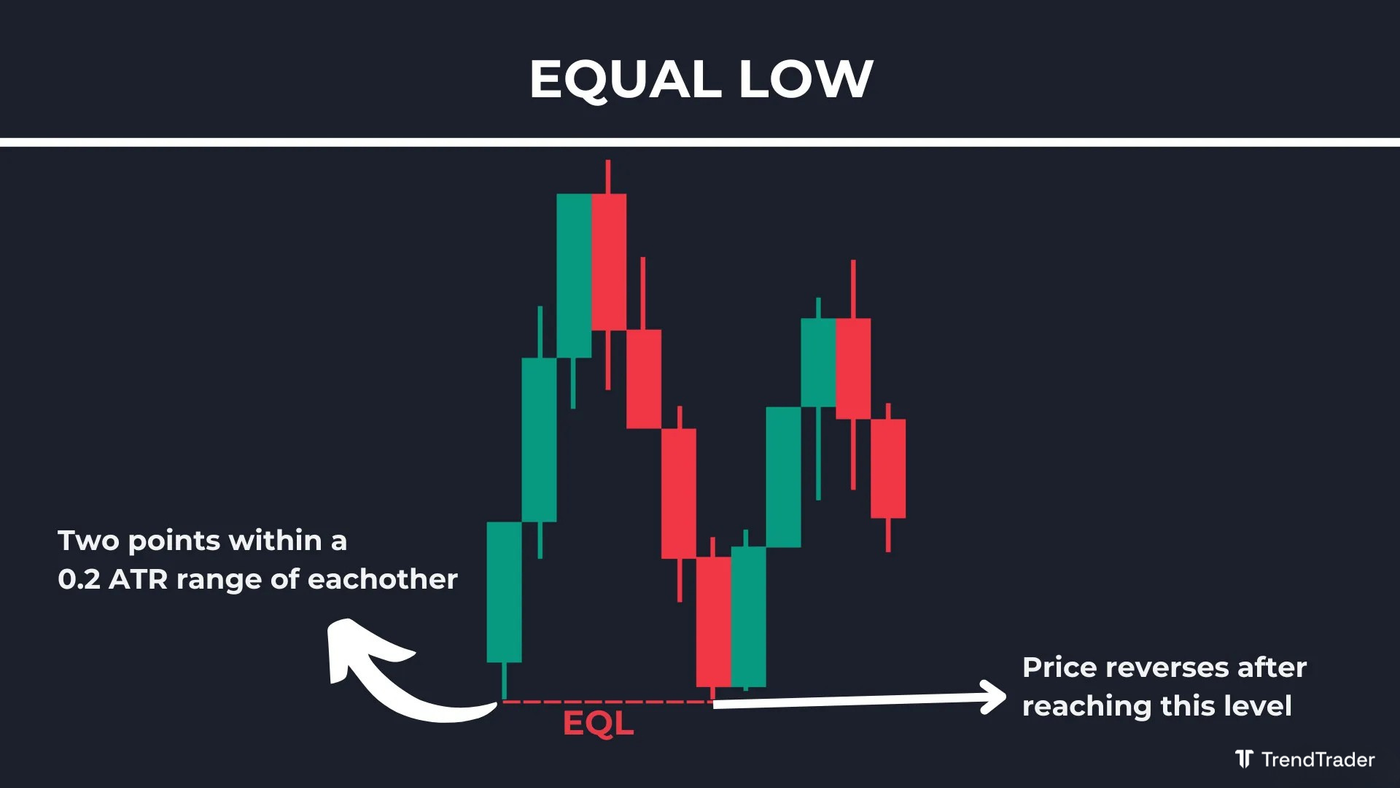
An equal low (EQL) forms when price reaches a previous swing low and rejects at approximately the same level, creating two lows at roughly the same price. In SMC and ICT-based trading, this is treated as a bullish signal. The equal low marks a support level where sellers have twice failed to push lower, suggesting buyers are in control at that price.
Equal lows are the bullish counterpart to equal highs. Where equal highs flag resistance and a bearish bias, equal lows flag support and a bullish bias.
How to Identify an Equal Low (EQL)
To find an equal low, identify a swing low on your chart: a trough where price reversed after moving down. Then watch for price to decline again and test the same level. When price reaches approximately the same low and rejects rather than breaking through, an equal low has formed. The candle retesting the level must not close below the original swing low.
The logic mirrors that of equal highs: price tried to break through a support level once and failed. The second test at the same level with another rejection confirms that demand is consistently stepping in at that price. Two bounces from the same low is stronger evidence of support than one.
Trading Using an Equal Low (EQL)
Equal lows are not standalone entry signals. They confirm a bullish bias, telling you the market is likely to reverse or continue higher from that level. Once an EQL forms, look for long entries on pullbacks rather than entering immediately at the level itself.
A trader who sees an EQL form can shift to a bullish outlook and begin looking for long setups. The EQL gives you the directional bias. You still need a specific entry point with a defined stop and risk-to-reward.
Common Strategy Using Equal Lows (EQLs)
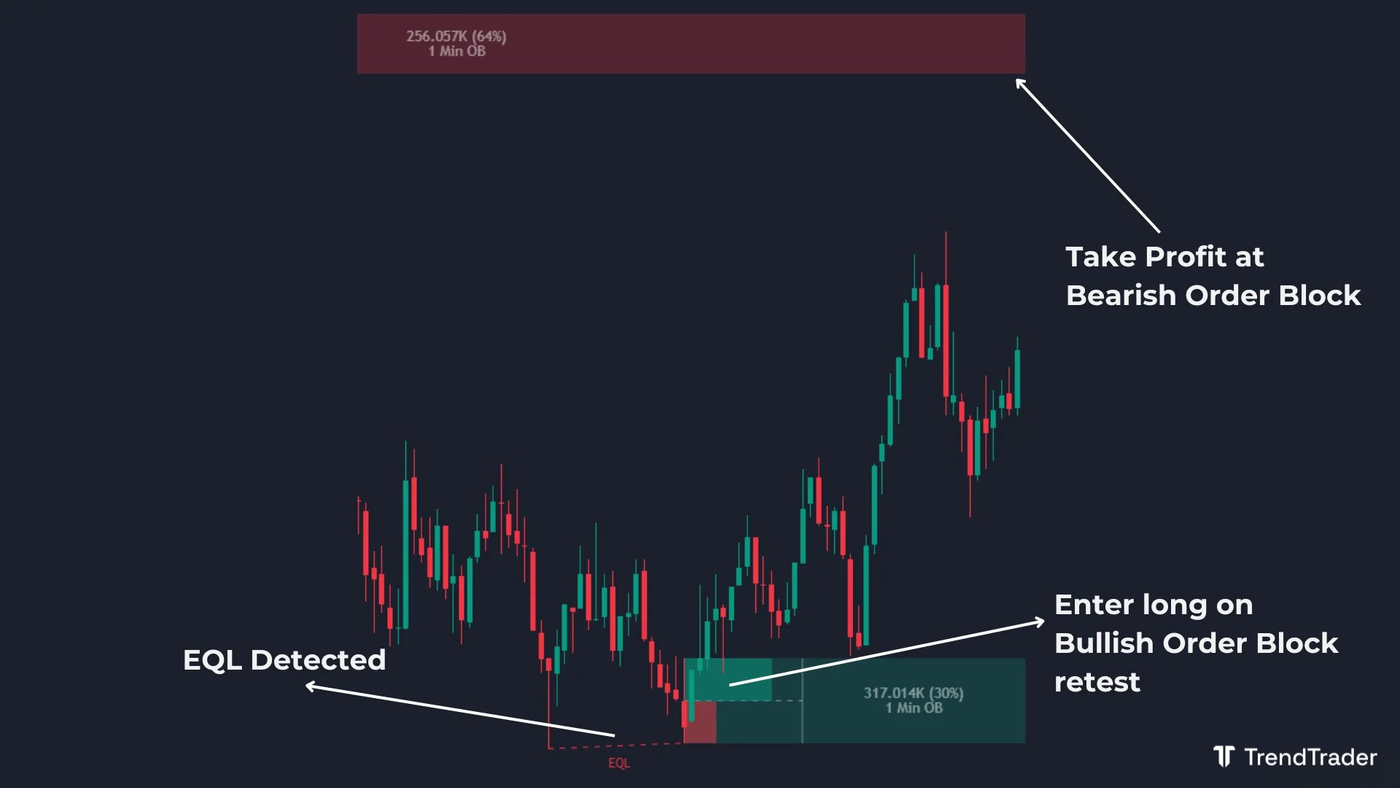
One effective approach pairs equal lows with a bullish fair value gap (FVG). After an EQL forms and confirms bullish bias, wait for price to pull back into a bullish FVG. That retest of the FVG is your entry zone. Set your stop below the FVG and target key levels above: a bearish order block, a resistance level, or a sell-side liquidity zone.
The combination works because the EQL confirms the directional bias and the FVG gives you a precise, defined-risk entry. Two independent signals pointing the same direction is more reliable than either one alone.
What Is the Best Timeframe for Using Equal Lows?
Equal lows work across all timeframes. Day traders commonly look for them on the 1-minute to 15-minute charts. Swing traders use the hourly, four-hour, and daily. As with most price action concepts, higher timeframe equal lows carry more weight because more participants are reacting to those support levels.
Shorter timeframe equal lows produce more signals but with more noise. An EQL on the daily or four-hour chart at a well-known support level is more meaningful than one on the five-minute chart. Top-down analysis applies: identify the EQL on a higher timeframe, then use a lower timeframe to time your entry.
What Is a Common Mistake When Trading Equal Lows?
The most common mistake is treating an equal low as an entry signal on its own. An EQL alone tells you support exists at a level. It does not tell you when to enter, where to put your stop, or how far price will travel. Entering long simply because an EQL formed, without additional confluence, leads to low-probability trades.
Build equal lows into a system. Use them to establish a bullish bias, then look for a fair value gap, order block, or liquidity grab at a nearby level to time your entry. The EQL frames the trade. Confluence executes it.
How Accurate Are Equal Lows When Predicting Price Movements?
Equal lows are reliable indicators of support and potential reversals, but no single pattern guarantees a specific outcome. Their usefulness increases when combined with other bullish confluence: a bullish fair value gap or order block at the same level, a broader uptrend on a higher timeframe, or a liquidity grab just below the equal low before the bounce.
An equal low that forms at a major support level on a higher timeframe, with additional confluence, is more significant than one that forms in isolation on a lower timeframe. Context always matters more than the pattern alone.
This article is for educational purposes only and does not constitute financial advice. Trading involves significant risk of loss. Do your own research and consult a licensed financial advisor before making any trading decisions.
Browse more trading concept guides on the TrendTrader blog.
