

Launched September 24, 2026. Fund A’s $1 million raise is closed, with trading preparation underway for the Q4 2026 target. Fund B is in development; deposits are not open.
An operating business.
A new token economy.
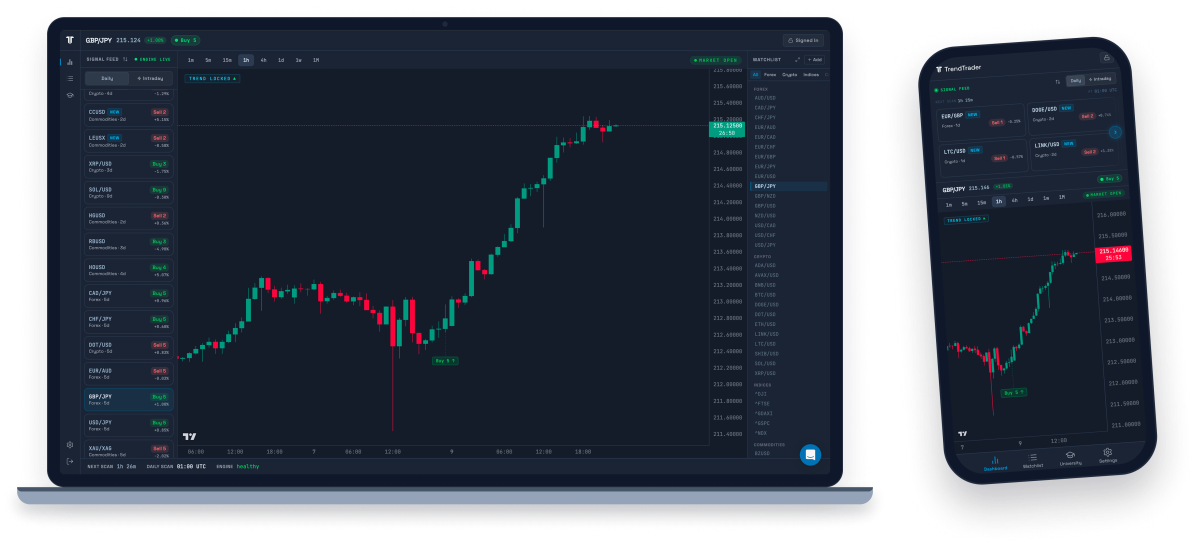
TrendTrader Pro is a profitable trading software business with an operating product, customers and subscription revenue. Our proprietary algorithm follows the market-maker cycle and delivers algorithmic trades across more than 1,000 markets.
TTP connects two parts of our fund strategy: profit-funded market purchases and burns from Fund A, and TTP-only participation in Fund B, our separately developed participant fund. The operating software business provides the research and product foundation behind that strategy.
The goal of TTP is twofold.
-
ProfitBuy TTPBurn
Connect trading profits to TTP purchases and burns.
Fund A’s policy directs 50% of available realized profits to open-market purchases of TTP and burns every token bought with that allocation.
-
TTPFund BTTP
Make TTP the route into Fund B.
Fund B would be open exclusively to eligible TTP holders, using TTP to allocate capital and receive settlements.
The first mechanism concerns Fund A’s profits; the second concerns participant capital under separate fund terms.
Why we chose a fair launch.
TrendTrader Pro was already a profitable software business, with a product, customers and revenue, when we launched TTP. We chose a public fair launch through Pump.fun so our community could buy through the market from day one.
TTP launched on September 24, 2026. Its initial supply served two purposes: public bonding-curve trading and liquidity for the PumpSwap market. The launch structure had no separate initial VC or team reserve waiting for scheduled release.
How TTP launched.

- Token created September 24, 2026 1 billion TTP · 6 decimals
- Public bonding curve 793.1 million TTP Public trading
- Graduated to PumpSwap The same evening 206.9 million TTP seeded
- LP tokens permanently burned Initial liquidity Withdrawal rights removed
- Network
- Solana
- Launch
- Pump.fun public curve
- Mayhem Mode
- Off
Public trading from the start.
TTP began trading on September 24, 2026 and graduated to PumpSwap later that evening. The entire initial issuance went into the bonding-curve mechanism, with 793.1 million TTP assigned to curve trading and 206.9 million retained for migration. The creation transaction also records a paid creator purchase through the curve.
A public launch connects price discovery to buyers and sellers from the outset. TTP’s initial allocation created no separate investor or team tranche with a future vesting calendar. That gives the community a clear launch structure to inspect alongside the company’s existing product and trading research.
Permanent initial LP-token burn.
At migration, the protocol deposited the remaining 206.9 million TTP into the TTP/SOL pool and burned the LP tokens issued for the initial liquidity. Those LP tokens represented withdrawal rights; burning them is separate from burning TTP. TTP held in the pool remains available for trading.
Issuance and trading today.
The mint uses six decimals, with mint and freeze authorities disabled. One billion is the initial issuance. Current total supply reflects subsequent burns and can be checked on the token explorer; circulating-supply providers apply their own published methodology.
TTP trades against SOL. Trading, network and app fees depend on the route used. Review the current Pump.fun/PumpSwap fee schedule and the quote in your chosen app before confirming a trade.
Find the complete Solana token address and verified market links in Buy & track TTP. Match the full address in your chosen app.
Prepare Fund A for trading.
Fund A is TrendTrader Pro’s private trading operation, using $1 million in company capital from its closed raise. We are preparing execution around gold, oil and Nasdaq, with planned risk of 0.5% of current equity per trade. Venue selection, portfolio limits and operating policies are being finalized for the Q4 2026 target.
 GoldPrecious metal
 OilEnergy
 NasdaqEquity index
The TTP economic flywheel
capital
execution
profits
compound
Fund A profit cycle
Fund A capital
TrendTrader Pro’s $1 million trading capital. The raise is closed; trading setup is in preparation.
Strategy execution
Trade gold, oil and Nasdaq with 0.5% planned equity risk per trade, subject to portfolio and execution limits.
Available profits
Allocate 50% of available realized profits to TTP purchases and burn every token bought with that allocation. Accounting rules remain to be finalized.
Retain & compound
Initially, the entire business half stays in Fund A. Retained profits increase trading equity and the dollar budget under the 0.5% risk rule.
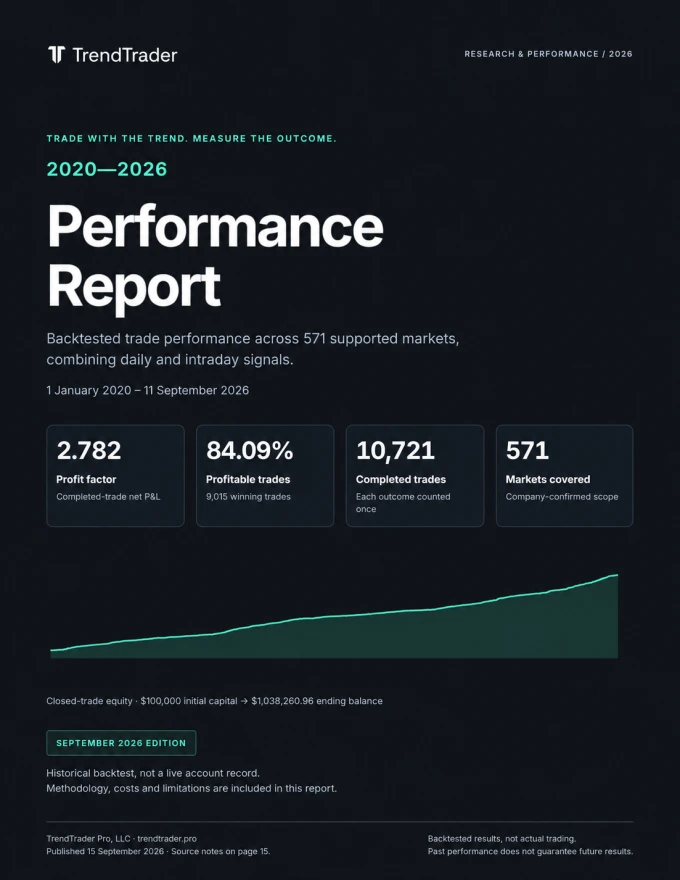
Our 2020–2026 Performance Report documents company-reported historical backtesting from January 1, 2020 through September 11, 2026. It examines daily and intraday algorithmic trades, including results, drawdowns, recorded trading costs and methodology.
Annual net trading P&L
*2026 through September 11. USD, after recorded commission.
- Profitable trades
- 84.09% — Profitable trades; read the report (opens in a new tab) Headline accuracy
- Backtest period
- 2020–2026 — Backtest period; read the report (opens in a new tab) January 1, 2020–September 11, 2026
The published backtest
- Starting capital
- $100,000
- Position size
- One contract, fixed
- What grows
- Balance only
- Status
- Published historical test
Fund A
- Starting capital
- $1 million
- Position size
- 0.5% of current equity
- What grows
- Balance and position size
- Status
- Trading targeted Q4 2026, subject to readiness
The $1 million raise is closed. Trading is targeted for Q4 2026, subject to compliance and execution readiness. Positions sized at 0.5% planned risk per trade, within execution and exposure limits. A focus on gold, oil and Nasdaq. Losses and withdrawals reduce that capacity.
0.5% planned risk. A changing dollar budget.
These example account balances show how the sizing rule responds to both growth and losses. They are not performance targets or a time series.
Dollar callouts magnify the planned risk budget.
One allocation, illustrated.
Illustrative exampleThe retained half increases trading equity and the dollar budget for the next trade.
(example)
every token burned
Dashed outline: starting equity of $1,000,000.
Position sizing and retained capital.
Fund A’s planned risk budget is 0.5% of current equity per trade, within portfolio and execution limits. Profits retained in the trading account add to the capital available for subsequent trades. Initially, the full 50% business allocation stays in the account; the other 50% funds TTP purchases and burns. Losses and withdrawals reduce trading equity and the next position’s risk budget.
Sizing methodology for Fund A
The original 10,721 completed trades reconcile to the published $938,260.96 net profit. The exported ledger does not provide each trade’s initial stop price, so it cannot establish the risk-based position size for a new replay.
The planned 0.5% risk rule and initial 50% profit retention are established. A Fund A simulation still needs trade-level initial stops, precise withdrawal timing, costs, margin and execution limits. Simply multiplying historical trades by a growing balance assumes those constraints away. The fixed-contract study and a risk-based Fund A simulation measure different approaches.
50% for purchases and burns.
50% for the business.
Under the policy, 50% of Fund A’s available realized trading profits funds open-market TTP purchases. Every token bought with that allocation is burned. The other 50% is the business allocation, initially retained in full inside Fund A.
Where the trading profits go
Illustrative exampleevery token burned
Retained capital returns to the trading account
Available realized profit
Illustration only. This is profit available for allocation, not deposits or total account value.
50% · $50,000 in market buys
Buy TTP at available execution prices, then burn 100% of those purchased tokens.
50% · $50,000 stays in Fund A
Initially retain the full business half in Fund A. Later uses may include retention, company growth or a TTP treasury.
The separate company treasury option
Management may later use the business allocation for retained capital, company operations and growth, or open-market TTP purchases for a company treasury. Treasury tokens are held assets, separate from tokens purchased for burning. Any treasury activity would have its own purchase, sale and balance reporting.
For example, a later allocation could direct 50% of total available realized profits to purchases and burns, 25% to retained capital and 25% to company growth. This illustrates one use of the business half; the initial policy retains that half in full.
What a market buy changes
Illustrative example, not live market data- TTP in the pool
- 1,000TTP
- Paired asset in the pool
- 1,000paired-asset units
No trade yet
Bought tray- Pool price (start = 100)
- 100index
Starting level
- Example supply
- 10,000TTP
Starting level
- Starting pool
The example pool holds 1,000 TTP and 1,000 of the paired asset. The price is the ratio between the two sides.
- Market buy
A buyer pays 333.33 into the pool and takes 250 TTP out. Fewer TTP and more of the paired asset means a higher pool price.
- Burn
The 250 TTP are burned. The pool does not change, so the price does not move. The supply is permanently lower.
- Later selling
Later, holders sell 400 TTP into the pool. The price falls below where it started. A buy and burn does not set a floor.
Allocation, timing and reporting.
Management chooses the timing of withdrawals and purchases around open positions, trading liquidity and operational readiness. Timing discretion does not change the 50% allocation. Reporting will distinguish amounts allocated from purchases and burns completed.
The operating policy will define deductible costs, prior-loss treatment, measurement periods and allocation authority before the first allocation. Unrealized gains do not fund the policy.
Each completed purchase and burn will have a transaction record. Burn reporting will identify the method and verified supply effect. Treasury purchases, sales and balances will be recorded separately.
The policy uses Fund A’s available realized trading profits. It does not allocate creator fees or participant capital from Fund B.
Fund B. Participate with TTP.
Fund B is our planned public-participation fund, exclusively for eligible TTP holders. Participants would allocate TTP and receive settlements in TTP. Fund B would follow the same trading approach as Fund A, with participant capital and separate fund terms.
Fund A has a defined $1 million capital base. Fund B would have no predetermined starting portfolio balance: its capital would depend on the TTP allocated by participants and the value realized when converted into trading collateral. We are developing the strategy, execution controls and reporting for this participant-funded model.
TTP into the strategy. TTP at settlement.
to collateral
back to TTP
Allocate TTP
Eligible TTP holders enter Fund B under its separate terms.
Convert and trade
TTP is sold for collateral. The strategy generates gains or losses, after costs.
Settle in TTP
Withdrawable value buys TTP for return to the participant.
Participants would allocate TTP, which the fund converts into the collateral needed for trading. At withdrawal, the participant’s withdrawable value would buy TTP for settlement. Trading results, fees and TTP prices determine the number of tokens returned.
Fund B’s eligibility, custody, valuation, fees and withdrawal terms will be published before participation opens. Holding TTP alone does not enroll a holder in Fund B. Fund A’s 50/50 policy is separate from Fund B participant capital and fees.
Make the activity inspectable.
We plan to publish Fund A results alongside the records that connect available realized profits to allocations, transfers, TTP purchases and burns. Reports will show costs, losing periods, prior-loss treatment and amounts awaiting execution. Company treasury purchases, sales and balances will appear separately.
Follow the evidence
View Fund A dashboard-
Off-chain
Payout record
Trading statement
Capital, closed P&L, costs and prior losses -
On-chain
Purchase transaction
TTP acquired
Execution record -
On-chain
Burn transaction
Supply reduction
Verified burn record
Published on the Fund A dashboard. One wallet for both the buyback and the burn.
The $TTP buyback and burn wallet is published on the Fund A dashboard; the reporting method and cadence follow with the first report. On-chain transactions provide one part of that record; performance reporting will also account for execution, costs and balances held at trading venues.
Two tracks. One direction.
-
Now Short term · Foundations
Grow the software. Prepare Fund A.
TrendTrader Pro
Grow software adoption and help traders use our algorithmic trades within their own process.
Fund A & TTP
Complete compliance, venue selection and execution controls. Target Q4 2026 trading, subject to readiness. Establish reporting for results, allocations, purchases and burns when profits are available.
-
Exchange access PlannedBuy orders Sell ordersBuyers meet sellersMedium term · Distribution & liquidity
Expand reach and trading access.
TrendTrader Pro
Expand software distribution through marketing, sales and customer education.
TTP
Pursue centralized-exchange listings and explore a market-maker relationship for liquidity and trading conditions. Evaluate company treasury purchases from the discretionary business half.
-
Long term · Fund B
Open Fund B to eligible TTP holders.
TrendTrader Pro
Advance our trading strategy and execution with the ambition to deliver industry-leading alpha. Build the research, controls and reporting needed to compete in professional fund management.
TTP participation
Develop Fund B around TTP-only participation and settlement. Its starting capital would depend on participant allocations, with no predetermined opening portfolio balance. Eligibility and participation terms will be published before deposits open.
Build the model
- Done
Fund A’s $1 million raise is closed.
- In progress
Complete Fund A’s compliance, venue selection and execution controls.
- In progress
Finalize profit accounting and establish reporting of actual activity. Publish results; implement the buyback and burn policy when funded by available realized profits.
- Planned
Develop Fund B for eligible TTP holders, with participant-funded capital and TTP-only entry and settlement.
Broaden access
- Done
TTP is live.
- Planned
Grow software adoption and distribution alongside TTP discovery.
- Planned
Explore a market-maker relationship for liquidity and trading conditions.
- Planned
Prepare and submit selected centralized-exchange applications.
- Planned
Evaluate a company TTP treasury under the separate business allocation.
We aim to expand access through trading apps and selected centralized exchanges while developing Fund A’s execution and reporting. The TTP page sets out the short-, medium- and long-term roadmap.
Where TTP stands today.

TTP
Verified contract and market links are published.
Fund A
Trading setup is in preparation.
Fund B
Participant-funded, exclusively for eligible TTP holders.
We never ask for a seed phrase. This website has no wallet connection, claim facility or deposit interface.
Official contract & buying information