 View on Solscan
Pump.fun
Buy from the official TTP market with a Solana wallet.
Buy on Pump.fun
The official token of TrendTrader Pro.
An operating trading software business, a public fair launch and a fund strategy built around TTP. Fund A has closed its $1 million raise. Its policy directs 50% of available realized trading profits to market purchases of TTP and burns every token purchased.
View Fund A dashboard
Fund A · $1M raise closed · Q4 2026 target

Verify the token address, then choose where to buy or follow the market.

Match this complete Solana address before buying. Token names and symbols can be copied.
Buy from the official TTP market with a Solana wallet.
Buy on Pump.fun
Use the Coinbase app’s Solana DEX experience, if TTP is available to you.
Buy on CoinbaseSwap for TTP on Jupiter with your Solana wallet.
Buy on Jupiter
Open TTP in Phantom to buy or swap with your wallet.
Open in Phantom
Buy TTP through FOMO’s app or web trading experience.
Open in FOMOUse the verified TTP links above. Coinbase DEX access depends on token availability and location; New York is excluded.

View the chart, recent trades and liquidity.
View chartFollow TTP’s price, market cap and trading volume.
View on CoinGeckoFrom the founder
Why we launched TTP, how it connects to TrendTrader Pro, and what comes next.
Watch on YouTube (opens in a new tab)The company behind the token
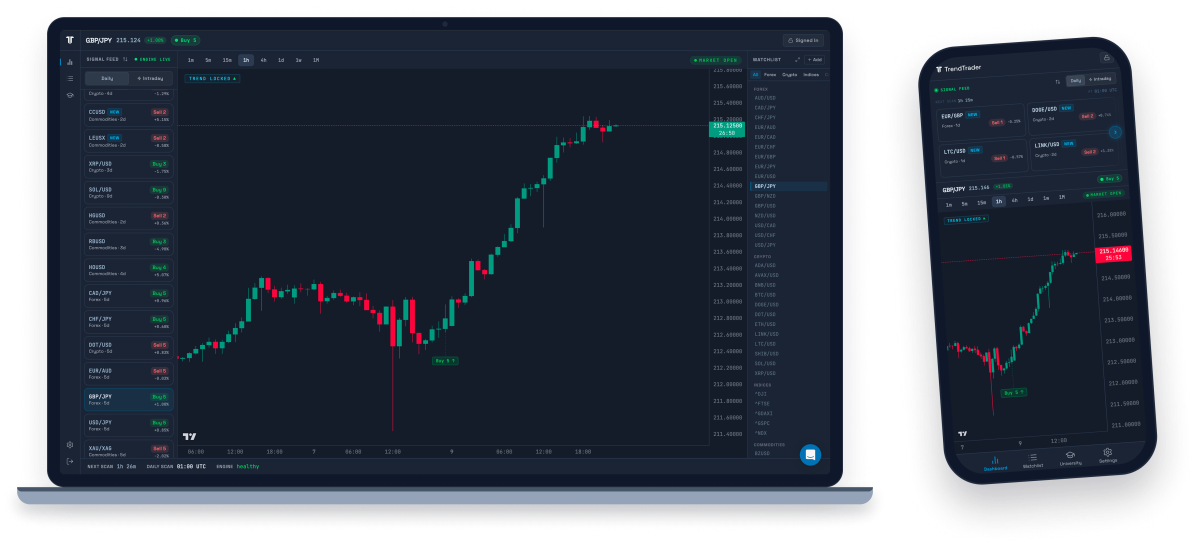
TrendTrader Pro is a profitable trading software business with an operating product, customers and subscription revenue. Our proprietary algorithm follows the market-maker cycle and delivers algorithmic trades across more than 1,000 markets.
Fund A is TrendTrader Pro’s private trading operation, using $1 million in company capital from its closed raise. We are preparing execution around gold, oil and Nasdaq, alongside the TTP purchase-and-burn policy. Fund B is the separate participant-funded program we are developing exclusively for eligible TTP holders.
Meet TrendTrader ProThe launch philosophy
TrendTrader Pro was already a profitable software business, with a product, customers and revenue, when we launched TTP. We chose a public fair launch through Pump.fun so our community could buy through the market from day one.
TTP launched on September 24, 2026. Its initial supply served two purposes: public bonding-curve trading and liquidity for the PumpSwap market. The launch structure had no separate initial VC or team reserve waiting for scheduled release.
TTP opened through a public market. Buyers could participate through Pump.fun’s curve, and trading now continues through the TTP/SOL market on PumpSwap.
The launch assigned supply to public trading and market liquidity. It did not create a separate initial investor or team tranche with a vesting calendar.
Pump.fun’s published curve rules set quotes as buyers and sellers traded. After graduation, PumpSwap’s pool supports ongoing trading and price discovery.
Research & performance
Explore the historical testing behind TrendTrader Pro. Our 2020–2026 Performance Report examines daily and intraday algorithmic trades, including results, drawdowns, recorded trading costs and methodology.
Our planned execution focuses on gold, oil and the Nasdaq equity index. The published report covers the broader historical study; the focused strategy needs its own documented results and live execution record.
 GoldPrecious metal
 OilEnergy
 NasdaqEquity index
2020–2026 Performance Report · 16 pages
Read the performance report (opens in a new tab)Company-reported historical backtest, January 1, 2020–September 11, 2026. See the report for the instruments, timeframes and testing assumptions.
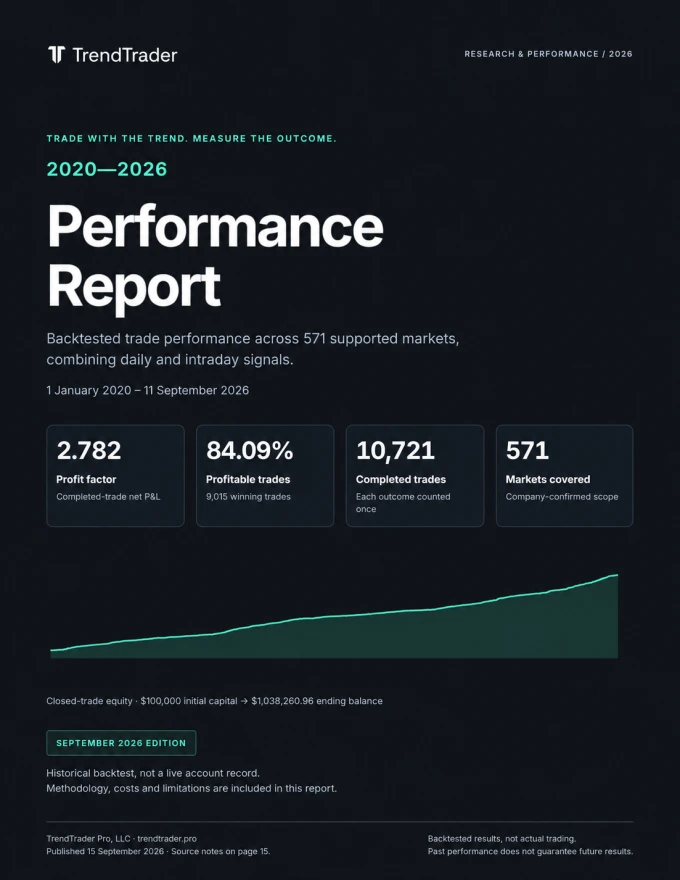
*2026 through September 11. USD, after recorded commission.
Fund A / Private company capital · $1 million
The $1 million raise is closed. Trading is targeted for Q4 2026, subject to compliance and execution readiness. Positions sized at 0.5% planned risk per trade, within execution and exposure limits. A focus on gold, oil and Nasdaq. Losses and withdrawals reduce that capacity.
These example account balances show how the sizing rule responds to both growth and losses. They are not performance targets or a time series.
Retained profits add to Fund A’s trading capital. The policy initially retains the business half in full, while the other 50% funds TTP purchases and burns.
Later uses of the business half may include retained capital, company growth or open-market TTP purchases for a company treasury.
The retained half increases trading equity and the dollar budget for the next trade.
Dashed outline: starting equity of $1,000,000.
The model
Under the policy, 50% of Fund A’s available realized trading profits funds open-market TTP purchases. Every token bought with that allocation is burned. The other 50% is the business allocation, initially retained in full inside Fund A.
Fund A profit cycle
TrendTrader Pro’s $1 million trading capital. The raise is closed; trading setup is in preparation.
Trade gold, oil and Nasdaq with 0.5% planned equity risk per trade, subject to portfolio and execution limits.
Allocate 50% of available realized profits to TTP purchases and burn every token bought with that allocation. Accounting rules remain to be finalized.
Initially, the entire business half stays in Fund A. Retained profits increase trading equity and the dollar budget under the 0.5% risk rule.
Retained capital returns to the trading account
Illustration only. This is profit available for allocation, not deposits or total account value.
Buy TTP at available execution prices, then burn 100% of those purchased tokens.
Initially retain the full business half in Fund A. Later uses may include retention, company growth or a TTP treasury.
No trade yet
Bought trayStarting level
Starting level
The example pool holds 1,000 TTP and 1,000 of the paired asset. The price is the ratio between the two sides.
A buyer pays 333.33 into the pool and takes 250 TTP out. Fewer TTP and more of the paired asset means a higher pool price.
The 250 TTP are burned. The pool does not change, so the price does not move. The supply is permanently lower.
Later, holders sell 400 TTP into the pool. The price falls below where it started. A buy and burn does not set a floor.
Management may later use the business allocation for retained capital, company operations and growth, or open-market TTP purchases for a company treasury. Treasury tokens are held assets, separate from tokens purchased for burning. Any treasury activity would have its own purchase, sale and balance reporting.
Management chooses the timing of withdrawals and purchases around open positions, trading liquidity and operational readiness. Timing discretion does not change the 50% allocation. Reporting will distinguish amounts allocated from purchases and burns completed.
Fund B · Public participation
Fund B is our planned public-participation fund, exclusively for eligible TTP holders. Participants would allocate TTP and receive settlements in TTP. Fund B would follow the same trading approach as Fund A, with participant capital and separate fund terms.
Fund A starts with $1 million in company capital. Fund B’s starting capital would depend on how much TTP participants allocate, with no predetermined opening balance. Fund B is in development; deposits are not open.
Read the mechanics
Eligible TTP holders enter Fund B under its separate terms.
TTP is sold for collateral. The strategy generates gains or losses, after costs.
Withdrawable value buys TTP for return to the participant.
Synchronizing price history…
| Time (UTC) | Open | High | Low | Close | Volume |
|---|
Discovering and verifying TTP markets.
| Market | Status | Liquidity | 24h volume | Liquidity share |
|---|---|---|---|---|
| Loading markets… | ||||
Finalized swaps · amounts exclude swap fees · times in UTC
| Time | Side | Price | Value | TTP | Market |
|---|
Holders are distinct on-chain owners with a nonzero balance, excluding known pool custody. Account balances are checked against current supply; the snapshot spans the reported collection interval. Holder change appears after 24 hours of verified snapshots. Addresses do not identify unique people. Burned supply is not attributed to a particular program or buyer.
| Owner | TTP balance | Share of total supply |
|---|
Market data via Alchemy, with Pyth SOL/USD when verified and fresh. TradingView Lightweight Charts™ · Copyright (с) 2025 TradingView.
The current price is the TTP/SOL PumpSwap reference price in USD. Period change compares it with the last PumpSwap execution at or before the period start. FDV is price multiplied by current total supply after burns; it is not independently verified circulating market cap. Volume and trade activity combine tracked pools, count each swap once and exclude swap fees. Historical USD values use the corresponding historical quote-token price. The chart shows five-minute executed-trade candles; the line connects their closing prices. Liquidity values actual pool balances at consistent reference prices, excludes virtual reserves and may include liquidity outside the current trading range. Pools with an unpriced quote asset remain visible but are excluded from the displayed valued-liquidity subtotal. Discovery covers PumpSwap, Meteora DLMM and Meteora DAMM v2; additional venues require verification. Missing history remains unavailable. Quiet markets can have a healthy feed without a recent trade.
Market access
From the first public market to the apps people already use, our goal is to make TTP easier to discover and trade.
TTP launched through Pump.fun and now trades through its TTP/SOL market on PumpSwap. This public market gives buyers and sellers direct access to the token, with trading activity and liquidity visible on-chain.
Wallets and trading apps bring token discovery, familiar funding options and swaps into one experience. Through routes such as Coinbase’s DEX experience, Jupiter, Phantom and FOMO, TTP can reach people where they already discover and trade crypto.
We plan to pursue selected exchange listings to reach new audiences and expand trading access. Exchange accounts and order books would give users another route to TTP, alongside its on-chain markets.
Current buying routes are listed in Buy & track TTP. Additional exchange listings will be announced when confirmed.
The roadmap
Our direction across the software business, Fund A and the token. These horizons describe goals; dates and delivery order remain open.
Grow software adoption and help traders use our algorithmic trades within their own process.
Complete compliance, venue selection and execution controls. Target Q4 2026 trading, subject to readiness. Establish reporting for results, allocations, purchases and burns when profits are available.
Expand software distribution through marketing, sales and customer education.
Pursue centralized-exchange listings and explore a market-maker relationship for liquidity and trading conditions. Evaluate company treasury purchases from the discretionary business half.
Advance our trading strategy and execution with the ambition to deliver industry-leading alpha. Build the research, controls and reporting needed to compete in professional fund management.
Develop Fund B around TTP-only participation and settlement. Its starting capital would depend on participant allocations, with no predetermined opening portfolio balance. Eligibility and participation terms will be published before deposits open.
Fund A’s $1 million raise is closed and trading preparation continues. Fund B is a separate participant-funded development program.

The full white paper
How Fund A’s trading profits, TTP purchases and burns connect with planned Fund B participation. Explore the full TTP tokenomics.
Read TTP tokenomicsA few things to know
TTP is the official token of TrendTrader Pro, launched on September 24, 2026. Fund A’s policy connects trading profits to TTP purchases and burns. Planned Fund B would use TTP as its sole participation and settlement asset for eligible holders.
Fund A has closed its $1 million raise from private angels. We target Q4 2026 for trading and are completing the compliance, venue and execution setup.
Fund A trades TrendTrader Pro’s $1 million in company capital and supports the purchase-and-burn policy. Fund B is being developed for eligible TTP holders to allocate their own TTP under separate fund terms. Its capital would depend on participant allocations, with no predetermined starting balance. Fund B deposits are not open.
Holding TTP does not grant company equity or a right to profit distributions. Participation in Fund B would require eligibility and a separate TTP allocation under Fund B’s terms.
Fund A’s policy uses 50% of available realized trading profits to buy TTP on the open market. Those purchases create demand at execution; burning every token bought through the allocation then reduces outstanding supply.
Software subscriptions continue through our existing checkout. The TTP utility focuses on Fund A’s purchase-and-burn policy and planned Fund B participation.
Match the full Solana token address in Buy & track TTP with the address shown in your chosen app. Use the official buying and explorer links on this page.
Last updated September 30, 2026