

Inversion Fair Value Gaps (IFVG) Explained: Definition & Strategy
An inversion fair value gap (IFVG) is an invalidated FVG that flips into a support or resistance zone. Learn what they are, how to identify them, and how to trade them.

An inversion fair value gap (IFVG) is a former fair value gap that price has broken through, flipping it from an imbalance zone into a support or resistance level in the opposite direction. A bullish IFVG signals potential long entries. A bearish IFVG signals potential short entries.
IFVGs are used by SMC and ICT-based price action traders to spot momentum shifts and time trade entries. To use them effectively, you need to understand fair value gaps (FVGs) first.
What Is an Inversion Fair Value Gap (IFVG)?
A fair value gap is a three-candle imbalance where the wick of the first candle and the wick of the third candle fail to overlap the body of the second candle. The space between those wicks marks the FVG, representing a price range where the market moved too fast to fill all resting orders.
An inversion fair value gap forms when price returns to that FVG and breaks through it, by either a wick or a candle close. The invalidated FVG does not disappear. Like an invalidated order block becoming a breaker block, the zone flips and plays a different role on retest.
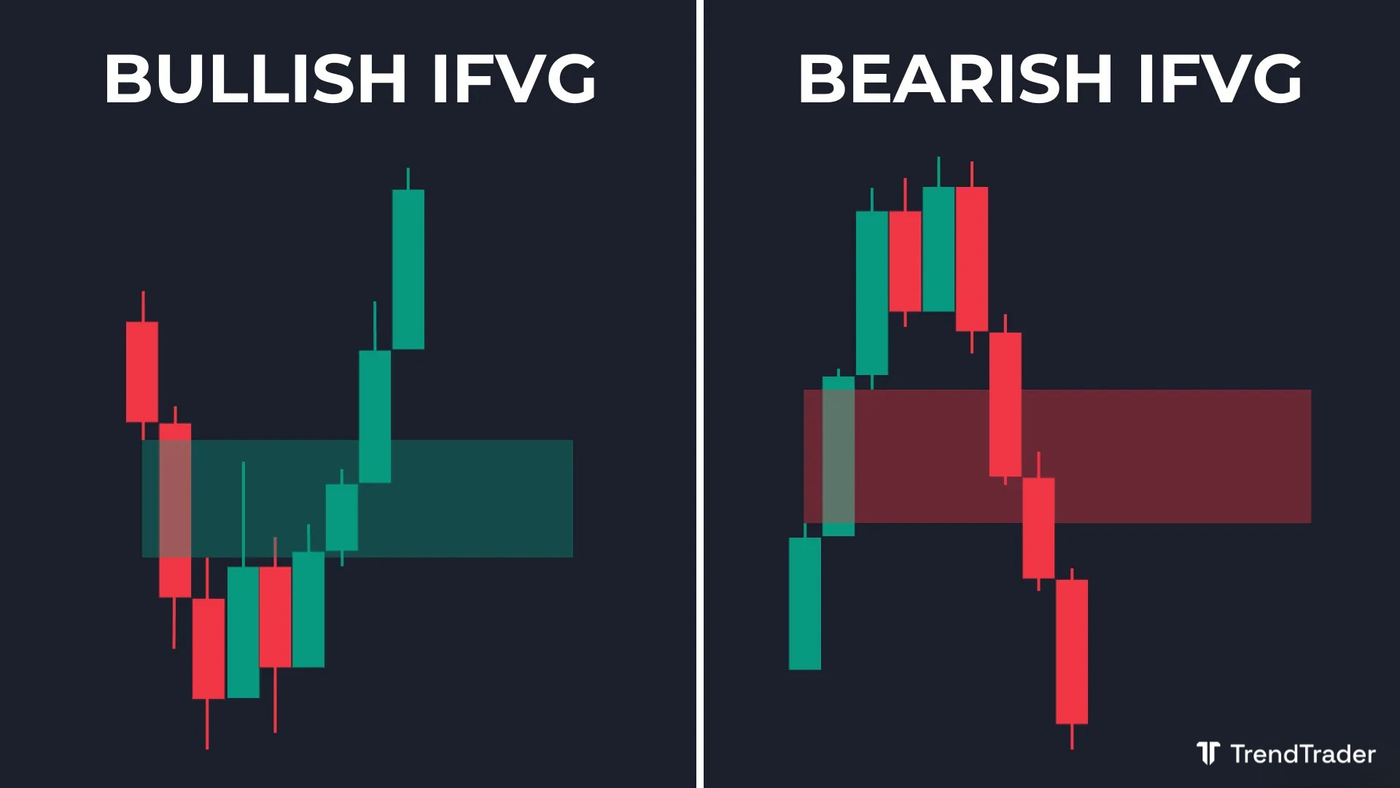
A bearish FVG that price breaks above becomes a bullish IFVG. Look for long entries on a retest. A bullish FVG that price breaks below becomes a bearish IFVG. Look for short entries on a retest.
How to Identify an IFVG
To identify an IFVG, first locate an active fair value gap. Then watch for price to return to that zone and push through it by wick or candle close. Once broken, the zone converts into an IFVG.
IFVGs remain valid only until price violates them in the new direction. If price trades through the bottom of a bullish IFVG, the zone is no longer valid. If price trades through the top of a bearish IFVG, discard it.
Bullish IFVG
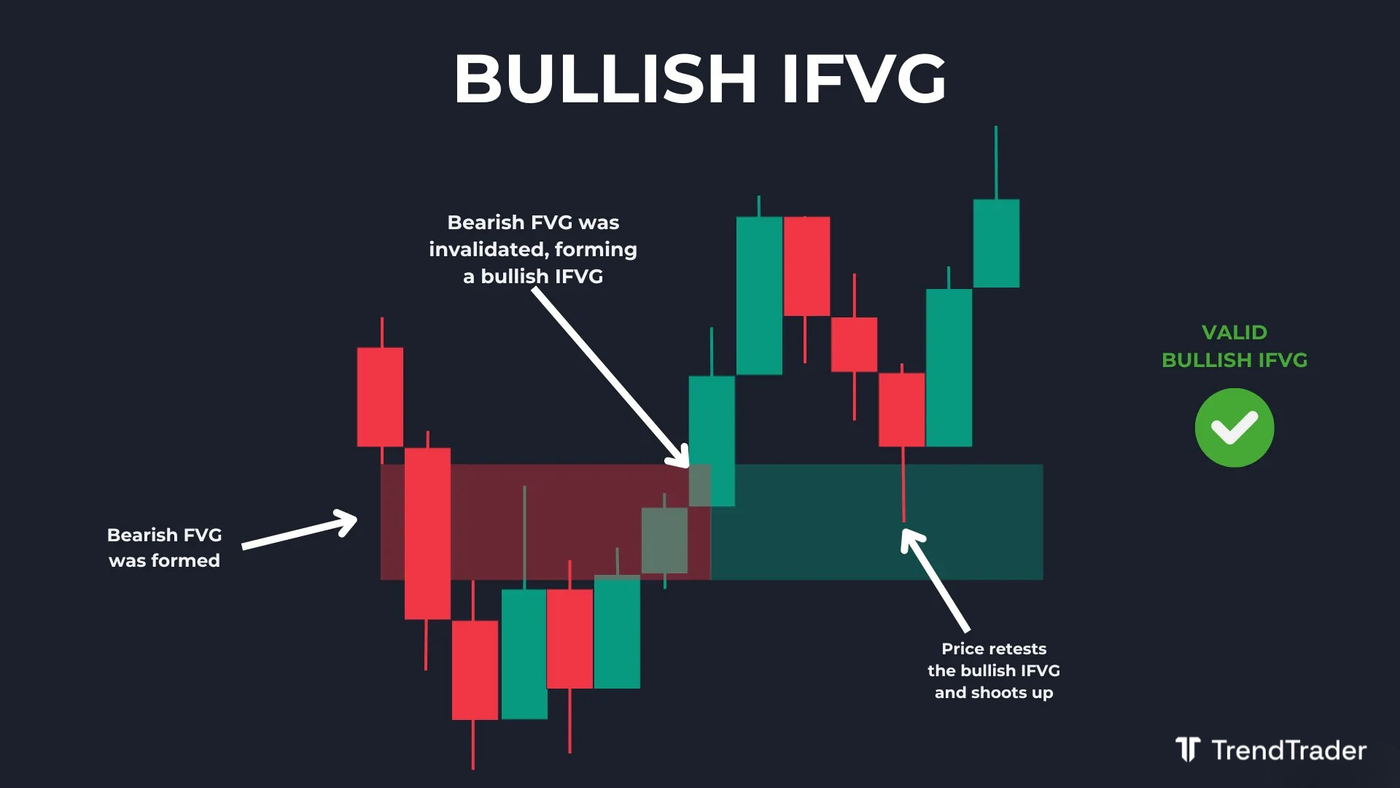
Find a bearish fair value gap. Wait for price to break above it by wick or candle close. Once broken, that zone becomes a bullish IFVG. When price retests it from above, look for long entry opportunities. The zone is invalidated if price later trades below the bottom of the bullish IFVG.
Bearish IFVG
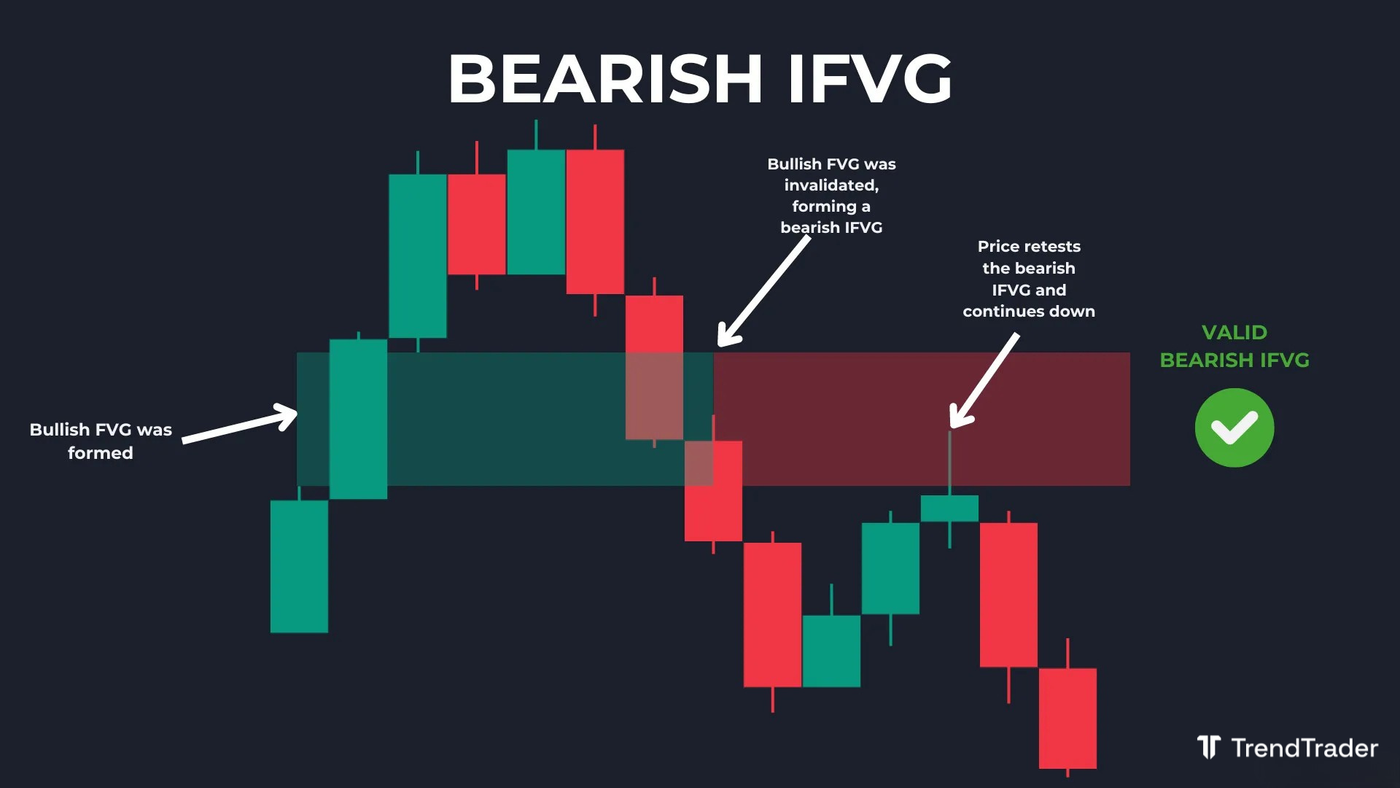
Find a bullish fair value gap. Wait for price to break below it by wick or candle close. Once broken, that zone becomes a bearish IFVG. When price retests it from below, look for short entry opportunities. The zone is invalidated if price later trades above the top of the bearish IFVG.
Trading Strategy with Inversion Fair Value Gaps
One of the most common IFVG strategies pairs the setup with a liquidity grab. The sequence is straightforward.
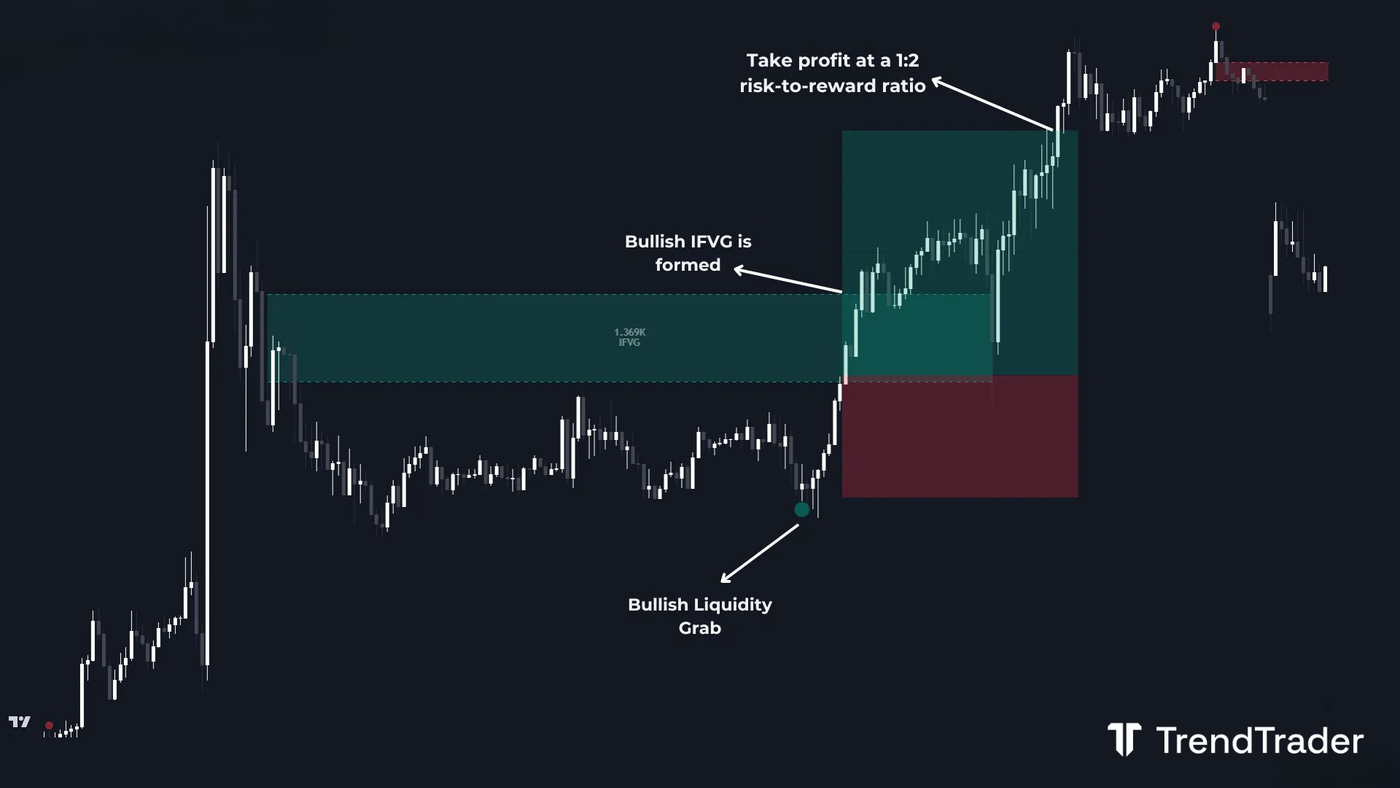
Wait for a liquidity grab: a sweep of a prior swing high or low that takes out resting stops. After the grab, watch for a fair value gap to form in the opposite direction. When that FVG is then invalidated by a wick or close, forming an IFVG, that is your entry signal. Set your stop loss below the IFVG for longs (or above it for shorts) and target a 1:2 risk-to-reward.
In the example below, a bullish liquidity grab sweeps stops beneath a prior swing low. Shortly after, price breaks back up through a bearish FVG, forming a bullish IFVG. Entering at the IFVG with a stop below the zone and a 1:2 target is a clean, defined-risk setup.
The IFVG gives you the level. The liquidity grab gives you the reason to trust it.
What Is the Best Timeframe to Trade Inversion Fair Value Gaps On?
IFVGs work across all timeframes. Scalpers use them on the one-minute and five-minute charts. Day traders use the 15-minute and hourly. Swing traders look at the four-hour and daily.
The same general rule applies: higher timeframes produce more reliable zones. An IFVG on the daily or four-hour chart carries more weight than one on the five-minute, because more participants are reacting to it.
Top-down analysis helps. Identify the IFVG on a higher timeframe, then drop to a lower timeframe to refine your entry with precision.
What Is the Difference Between a Fair Value Gap and an Inversion Fair Value Gap?
A fair value gap is a three-candle imbalance where the first and third candle wicks do not overlap the second candle’s body. That gap between the wicks represents an area of unfinished business in the market.
An inversion fair value gap is what an FVG becomes after price breaks through it. Where an active FVG expects price to fill it and reverse, an IFVG expects price to use the former gap as new support or resistance on a retest.
Short version: an FVG is a live imbalance. An IFVG is a flipped imbalance.
How Do You Avoid Bad Trades with Inversion Fair Value Gaps?
Trading IFVGs with confluence is more consistent than trading them in isolation. A retest of an IFVG alone is not a signal.
Strong confluence factors to combine with IFVGs include: a liquidity grab at or near the zone, alignment with the higher-timeframe trend, a breaker block or order block at the same level, and a clear market structure shift before the retest.
The more independent factors that agree, the stronger the case for entry. When confluence is thin, skip the trade.
This article is for educational purposes only and does not constitute financial advice. Trading involves significant risk of loss. Do your own research and consult a licensed financial advisor before making any trading decisions.
Browse more trading concept guides on the TrendTrader blog.
