

TTP Token Explained: How the Fund A Buyback and Burn Works
TTP token is the TrendTrader Pro token on Solana. Half of Fund A's realized profits buy TTP on the open market and burn it, half stays in the fund. Here is how it works.

The TTP token is the Solana token issued by TrendTrader Pro. It launched on September 24, 2026 with a fixed supply of one billion, and both mint and freeze authorities revoked. Half of every realized profit from Fund A buys TTP on the open market and burns it. The other half stays in the fund and compounds.
That last sentence is the whole idea. A token whose supply is tied to what a real trading fund actually earns, issued by a company that was already selling software before any of this existed.
Here is what TTP is, how the buyback and burn works, why only half the profit funds it, and what we are building next. Every fact below is also published on the TTP page and in the TTP tokenomics paper.
What is the TTP token?
TTP is a Solana token issued by TrendTrader Pro, deployed through Pump.fun on September 24, 2026 at 8:00 pm ET. Its supply is fixed, and the only ongoing supply mechanic is burning.
The facts you can verify yourself on any Solana explorer:
- Supply at launch: 1,000,000,000 TTP
- Standard: Token-2022, 6 decimals
- Mint authority: revoked at deployment. No new TTP can ever be created.
- Freeze authority: revoked at deployment. No wallet can be frozen.
- Contract address: 5iqjhP5ig6JWdXQf6hYAwojZeMf11pTCvH87gCQtpump
- Where it trades: PumpSwap, after graduating from the Pump.fun bonding curve on launch day, and Meteora. Coinbase lists TTP through its in-app Solana DEX route, subject to eligibility and location.
Supply only moves in one direction. Tokens burned by holders since launch have already taken the on-chain supply below the original figure, and every profit-funded buyback will burn what it buys.
Match the complete address on the TTP page before you interact with any token using our name or symbol. Names and tickers can be copied. A full contract address cannot.
Why did a profitable software company launch a token?
Because we wanted to trade the algorithm ourselves, and a token let us tie that trading to something holders can verify on-chain.
TrendTrader Pro started as software. A rules-based trend-following algorithm, sold as a subscription. It became profitable the ordinary way: build the product, charge for it, keep the customers. If you are new here, start with what TrendTrader Pro is and the market maker cycle the platform is built around.
Then we asked what would actually make us stand out. The answer was to run the strategy with our own capital. So we raised Fund A: $1 million, closed, trading in Q4 2026.
Five years ago you could not tie a token to a fund like this. On-chain venues now run perpetuals with execution, fees, and slippage in the same territory as a traditional broker. The infrastructure caught up with the idea.
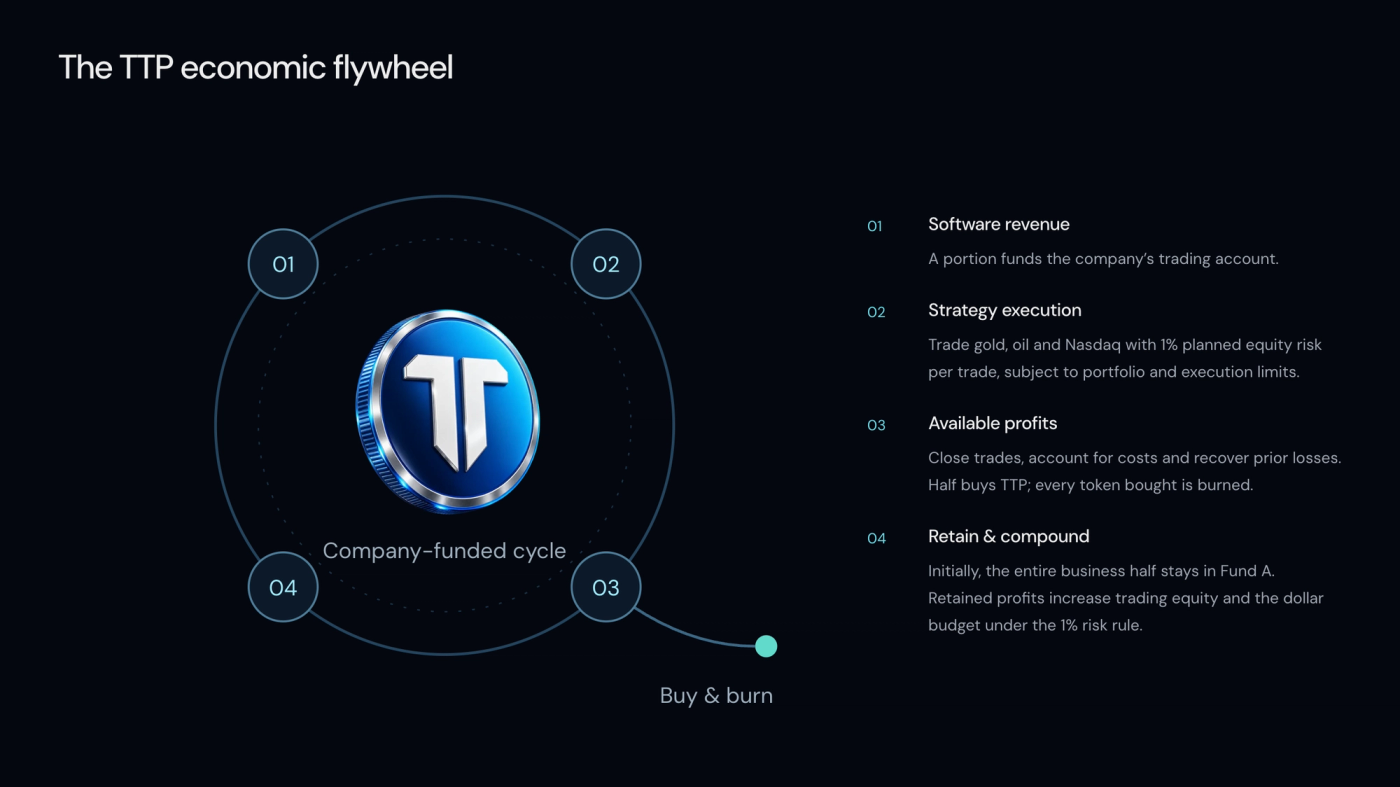
So TTP sits inside the business instead of next to it. A real company, a real fund, and a token whose supply is tied to what the fund earns.
What is Fund A?
Fund A is a $1 million proprietary trading fund run by TrendTrader Pro. The raise closed in September 2026, and the fund begins trading in Q4 2026. The exact date will be announced.
Fund A trades the TrendTrader Pro algorithm in three markets: gold, oil, and the Nasdaq. Each position is sized at a planned risk of 1% of current fund equity, within execution and exposure limits. That sizing rule matters for the token, and the next two sections explain why.
Our published 2020 to 2026 Performance Report covers the historical testing behind the algorithm. It is research context, not a live fund track record, and it does not forecast what Fund A will earn. Fund A can lose money.
How does the TTP buyback and burn work?
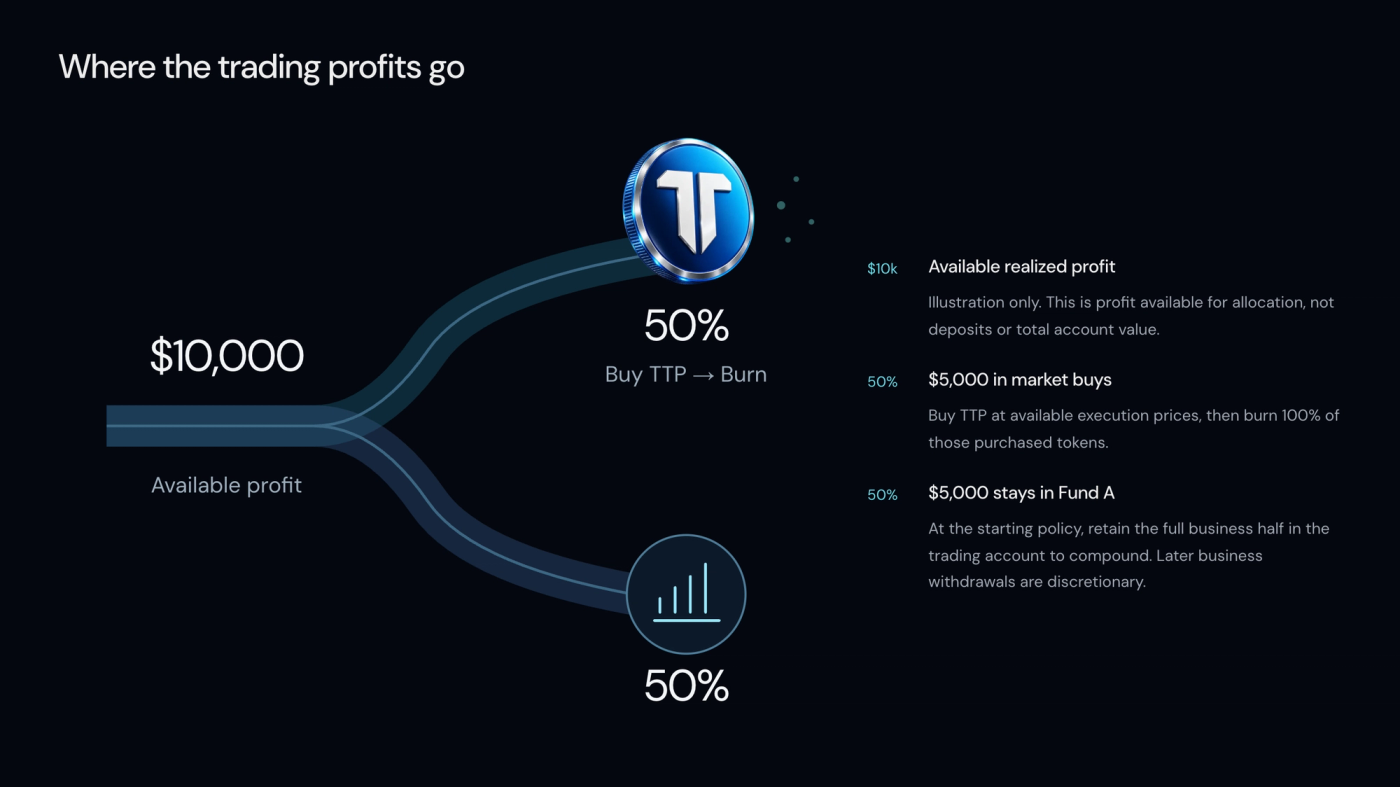
When Fund A closes trades and has available realized profit, after costs and after recovering any prior losses, that profit splits in two. Half buys TTP on the open market and burns 100% of the tokens bought. Half stays in Fund A as trading capital.
One allocation, illustrated with round numbers. If a $1 million account produces $100,000 of available profit, $50,000 funds TTP buys and burns and $50,000 stays in the account. Trading equity is then $1.05 million, and the next trade's 1% planned risk budget is $10,500. The assumed profit is arithmetic, not an expected return.
Every completed purchase and burn will have its own transaction record, so anyone can verify it on Solana. Sending tokens to a treasury or a vesting contract would not be presented as a burn.
Three things the buyback is not
It is not automatic price support. A market buy removes tokens from a liquidity pool and a burn reduces supply. Neither establishes a price floor, and later selling by anyone can move price the other way.
It is not a fixed schedule. We intend to process available profits one to three times a week, with no fixed days. A losing period creates no obligation to buy.
It is not a promise of a number. No available profit means no profit-funded buyback.
Why does half the profit stay in the fund?
Because compounding starts with the profits you keep.
The published performance report held its order size at one contract for the whole test. Its balance grew, but its position size never did. Fund A works differently. Retained profits raise the fund's equity, and the 1% risk rule turns that into a larger dollar budget for the next trade. Losses and withdrawals shrink it the same way.
The same dollar cannot both buy a token and stay in the account. That is why the split exists. Half of available profit goes out to buy and burn. Half stays so the next trade is sized off a bigger base.
Existing subscription revenue supports the business, so at the start the entire business half stays in Fund A. Later business withdrawals are discretionary and would be reported.
Where is TTP going next?
The buyback is the first connection between the token and the business. The second is participation.
We are developing a hedge fund subsidiary whose only deposit asset would be TTP. Participants would deposit TTP, the fund would convert it into trading collateral, run the strategy, and settle each participant's share of gains or losses back in TTP. Direct SOL, ETH, or stablecoin deposits would not be accepted.
That is the piece we are building with legal counsel. It is a direction, not a launch. The fund is not accepting deposits, no participation terms have been announced, and eligibility, fees, custody, withdrawal windows, and legal structure are still being designed. We will announce it properly when it is ready, not hint at it.
What TTP is not
Being precise here protects holders and protects us.
- Holding TTP does not give you equity in TrendTrader Pro, a claim on company assets, or an entitlement to revenue or Fund A's trading profits.
- TTP currently carries no governance rights, staking rewards, or platform discounts. Subscriptions are still paid through our normal checkout, on the pricing page.
- We do not describe TTP as an investment, and nothing in this post is a recommendation to buy or sell it.
How do I verify TTP and follow along?
Start with the contract address. The TTP page carries the address, a copy button, explorer links, and every official venue.
- The TTP tokenomics paper is the full white paper: distribution, the profit policy, the participation model, transparency commitments, and the open risks.
- Fund A milestones, completed burn transactions, and listing updates are posted from the company X account, @trendtraderalgo, and here on the blog.
Frequently asked questions
What is the TTP token?
TTP is the official token of TrendTrader Pro, launched on Solana through Pump.fun on September 24, 2026 with a fixed supply of one billion tokens and revoked mint and freeze authorities. Half of Fund A's realized profits buy TTP on the open market and burn it.
What is Fund A?
Fund A is a $1 million proprietary trading fund raised and closed by TrendTrader Pro in September 2026. It begins trading in Q4 2026 in gold, oil, and the Nasdaq, sizing each position at 1% planned risk of current equity.
Does the TTP buyback guarantee the price goes up?
No. Market purchases and burns reduce supply, but they do not set a price floor. Buybacks only happen when Fund A has available realized profit, and trading can lose money.
How often do the buybacks happen?
There is no fixed schedule. We intend to process available profits one to three times a week, with no set days. A period with no available profit produces no buyback.
Can I deposit TTP into the fund today?
No. The TTP-only participation program is planned and under legal review. The fund is not accepting deposits and no terms have been announced.
Where do I find the official TTP contract address?
On the TTP page. Match the full Solana address before interacting with any token using our name or ticker.
Can I pay for a TrendTrader Pro subscription with TTP?
No. Subscriptions run through our normal checkout. Holding TTP does not unlock platform access or discounts.
A note on risk
This post is educational and is not financial, investment, or legal advice. Digital assets are volatile and you can lose your entire position. TrendTrader Pro does not describe TTP as an investment, and holding TTP confers no equity, revenue share, or claim on Fund A. Fund A trading can lose capital, past performance does not guarantee future results, and buybacks depend on available profits. Do your own research or consult a licensed advisor. Our full disclaimer has the detail.
